
What Every Merger Demands
Resilience and rebuilding across the Chain Bridge.
What Every Merger Demands
Resilience and rebuilding across the Chain Bridge.
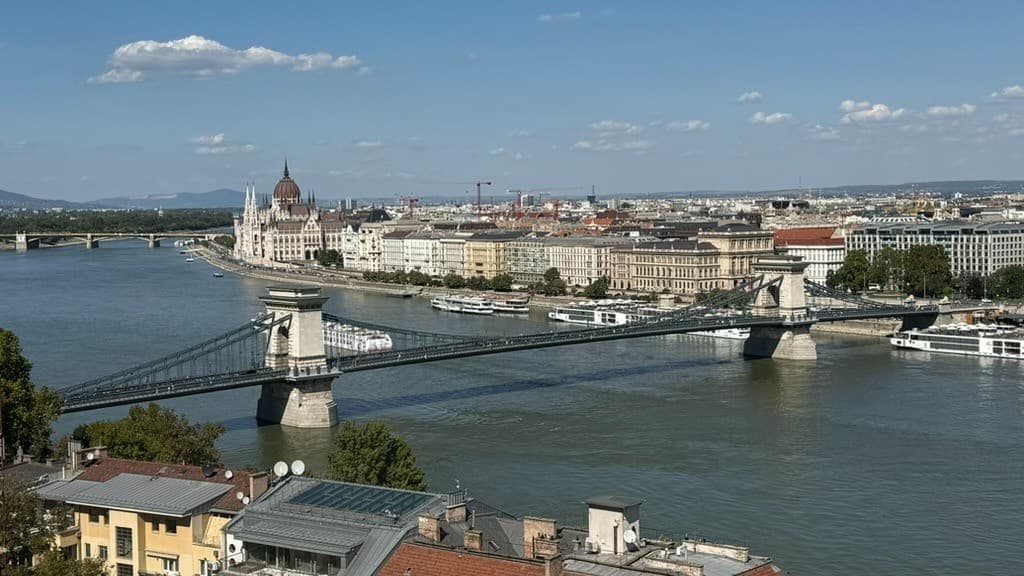
This morning I'm writing from the balcony of my room at the Marriott Budapest on the Pest side of the city with a view that looks across the Danube. Straight ahead rises Buda Castle, seat of kings, destroyed and rebuilt through centuries of conflict. Scanning to the right, I see the historic Chain Bridge, built in 1849, which links two once-separate cities — Buda and Pest — into one. Above it all, the towers of Fisherman's Bastion frame the spire of Matthias Church pointing heavenward, a reminder of faith and resilience perched high on the hill.
The Danube before me is more than water; it's music. And that takes me back to my university days. My undergraduate degree was in Vocal Performance, but music for me was never just about singing. While at university, I also played trombone in bands and orchestras, with some piano on the side. That's partly why Johann Strauss II's "The Beautiful Blue Danube" — so familiar you find yourself humming its melodies without notice — has stayed with me throughout my life.
If you know the tune — na na na na na… da-da, da-da — I've just planted it in your head. You're welcome. So here I am, finally sitting by that river.
Rivalries Across a River
While being on these banks today, it's easy to forget how fiercely Buda and Pest once clung to their separate identities.
On one side of the Danube was Buda: hilly, historic, home to aristocrats and the royal court. Old money. Old power. They looked down on Pest as shallow, noisy, and unrefined.
On the other side was Pest: flat, booming, commercial. Merchants, bankers, and traders hungry for growth. They saw Buda as pompous, backward, and clinging to faded glory.
The river between them wasn't just water. It was prejudice. Distrust. Contempt. For centuries, they defined themselves against each other: "We are not like them." "They don't understand us."
The Bridge That Changed the Story
The Chain Bridge was more than an engineering achievement; it was a cultural provocation. For centuries, Buda and Pest had defined themselves against each other. But once the bridge opened, nobles from Buda and merchants from Pest could no longer avoid one another. They crossed the same span, met face-to-face, and conducted business together.
The bridge didn't erase prejudice overnight, but it forced a new reality: connection became unavoidable. That's what bridges do. They don't just close distance; they confront identity. They require us to see the other — and, eventually, to see ourselves differently.
The Visionary Who Reframed Identity
Into this stalemate stepped Gyula Andrássy, Hungary's first Prime Minister. Once a fiery revolutionary sentenced to death in absentia, Andrássy returned to Hungary transformed. He didn't cling to the identity that had once defined him. Instead, he emerged as a pragmatic statesman who understood the stakes:
""We cannot be half a nation with half a capital."
His words reframed the issue from rivalry to destiny. But the deeper story is this — before Andrássy could reshape a nation, he first reshaped himself. That is the essence of leadership. Cultures do not change by decree. They change when leaders dare to let go of who they were, in order to serve what the moment requires.
Andrássy released the revolutionary's identity and stepped into the statesman's role — making him capable of guiding Hungary into its new future.
The Merger That Required Surrender
In 1873, Buda, Pest, and the quieter Óbuda merged to form one city: Budapest. But a merger is never just structural. It requires surrender. For centuries, Buda and Pest defined themselves by what they were not. Buda was not noisy; Pest was not pompous. To become Budapest, both had to relinquish those egoic identities and open to something larger.
Organizations face the same challenge. A merger, an acquisition, or even a culture transformation requires more than integrating systems or announcing a new vision. It demands that people — and leaders first — release the old stories of who they've been.
This is where the ego resists most fiercely. The ego whispers: "This is who I've always been. If I let go, I'll lose myself." But conscious leadership recognizes the illusion in that whisper. You are not your old identity, nor the new one that your ego tries to construct in its place.
Real leadership is the courage to loosen identity's grip altogether — to step out of the prison of ego and lead from presence, service, and possibility.
Leadership Lessons
Alignment begins in tension. Leaders don't wait for harmony; they forge it in the middle of rivalry and pride. Bridges precede belief. Shared connection must come before shared conviction. Every merger requires surrender. Old identities must be released so a larger wholeness can emerge. Leaders must go first. When leaders free themselves from egoic identities, they model the presence that makes real transformation possible. The whole is greater than the sum of its parts. What once seemed incompatible — Buda too old, Pest too brash, Óbuda too modest — merged into a capital that could rival Vienna.
Closing Takeaway
Standing by the Danube today, I see more than a beautiful river. I see the truth that every merger — whether between cities or inside organizations — requires courage. Not just the courage to imagine a new future, but the courage to release the ego's grip on identity itself.
Cultures don't transform because we declare them different. They transform when leaders go first — surrendering the illusion of who they must be, and leading instead from presence, clarity, and service. When that happens, what once seemed impossible becomes not only imaginable, but inevitable.