
Bridges, Scars, and Courage
Bridges, scars, and the courage to choose otherwise.
Bridges, Scars, and Courage
Bridges, scars, and the courage to choose otherwise.
Today my wife and I took a tour from Split into Bosnia and Herzegovina — about a two-hour drive across the border. The highlight was the city of Mostar, with its iconic bridge, winding bazaars, and layers of history. Along the way we stopped in hillside villages, passed Ottoman ruins, and drove through canyons carved by the Neretva River.
It was beautiful — but also sobering.
For me, Bosnia and Herzegovina has long been a place of heavy words. In the 1990s, while I was starting a marriage, raising a young family, and trying to earn a living as a young professional, names and headlines from this region still pierced the noise of daily life:
"Bosnia. Milošević. Radovan. Sarajevo. Ethnic cleansing. Genocide.
Those words surface in my mind even now, unprompted — after thirty years and all the clutter life has added since — and that in itself says something about how deeply they were etched into my memory. News about these events was everywhere — relentless, unforgettable. I knew that war and other atrocities were happening a world away, but I had no understanding of the context or the why. They were just headlines to me. Information, not experience.
Yes, being here brings back a flood of memory. Only now, for the first time, I am learning the context — the history, the fault lines, the human weight of what happened here.
A Crossroads of Empires
Slavic peoples — ancestors of today's Bosniaks, Croats, and Serbs — settled here in the 6th and 7th centuries. They were all the same people. The same villages. The same bloodlines.
But empire redrew identity along religious lines, compelling families and neighbors to see each other as Muslims, Catholics, or Orthodox. Politics, power, and centuries of outside rule shaped loyalties not around kinship but around which empire ruled at the time. Ottoman rule tied people to Islam. Austro-Hungarian oversight reinforced Catholic identity. Serbia looked east to Orthodox Moscow and Constantinople. People who had shared food and farms were slowly taught to sort themselves by altar, empire, and flag.
This is why "history made them so" is not a throwaway line. It's the sobering truth of the Balkans: neighbors divided not by blood but by centuries of politics, empire, and power deciding whose story would be told.
Even the languages remain nearly identical. As one local told us: "Croatian is like American English, Bosnian like British, Serbian like Canadian or Australian. There's no real difference — we just love to complicate things here."
Mostar itself reflects five eras: medieval beginnings as a settlement along the Neretva, guarded by mostari or bridge keepers; four centuries of Ottoman rule that left mosques, bazaars, hammams, and the Old Bridge; the Austro-Hungarian period with its schools, railways, and architecture; the Yugoslav years under Tito; and finally, the devastation of war and the fragile peace that followed.
Even the country's name carries history. Herzegovina literally means "the land of the duke," after a 15th-century noble who styled himself Herceg from the German word Herzog which translates to "Duke."
A Glimpse of Daily Life in Počitelj
Not all of Bosnia's history is written in treaties and battles. Some of it is etched in the daily rhythms of life.
In the hillside town of Počitelj, I passed the remains of an Ottoman han, or inn, and a hammam, or bathhouse, both built in the 17th century. The han once housed traders and travelers; the hammam served as a community bath.
These weren't just functional buildings. They were places where strangers became neighbors, where merchants swapped stories, where the everyday texture of life unfolded. Bosnia and Herzegovina is remembered for its wars, but it also carries this quieter legacy: inns, bazaars, and baths where people paused, gathered, and connected.
A Divided System
The war of the 1990s left Bosnia and Herzegovina divided into two entities: the Federation of Bosnia and Herzegovina (mostly Bosniaks and Croats) and Republika Srpska (mostly Serbs).
To prevent domination by any one group, the Dayton Accords — which formally ended the 1990s conflict — created the world's only three-member presidency: one Bosniak, one Croat, one Serb, rotating as chairman. It keeps the peace, but often paralyzes decision-making.
Systems like this are designed to freeze conflict, not necessarily to foster unity. It is a reminder that culture is not just the people; it is the systems and structures under which people operate. And the system will always win, in whatever way it is designed. If the structure enforces separation, separation is what endures.
A Schindler in Mostar
In Mostar I learned of Zoran Mandlbaum — a Jewish leader whom many have come to call the "Oskar Schindler of Bosnia."
The comparison is not exact. Schindler was a German industrialist, part of the dominant group in his time, who used his privilege to shield Jews from annihilation. Mandlbaum was Jewish himself, part of a community long acquainted with persecution, who risked his life to protect Serbs and Bosniaks in the 1990s.
What unites Schindler and Mandlbaum is not their background, but their conscience. In a city divided by barricades and sniper fire, Mandlbaum crossed the front lines daily. He carried food, medicine, and letters. He forged identity cards so people could escape. He refused to see enemies — only neighbors.
The parallel struck me deeply. In Kraków, I wrote of Schindler. And here in Mostar, I discover Mandlbaum. Different wars, different roles, but the same truth: leaders always face a choice. They can inflame division, or they can protect dignity. They can use fear to tighten control, or they can risk themselves to serve others. Leadership is never neutral. It either deepens the fracture or it heals it. Mandlbaum's story shows that even in the most divided times, leaders can choose the latter.
Ivanka's Story
Our tour guide, Ivanka, is 55 years old. She was in her twenties when the war broke out. Her father served in the Yugoslav army. Her mother was Serbian. In her family, as in so many here, the fault lines of identity cut right through the home.
She lost a brother in the war — just 17 years old. Many of her classmates and teachers also died. For years afterward, she lived in grief. "Ten years of crying every day," she told us. It was her father's words that finally helped her forward: "We cannot change the world or the people. We can only change ourselves."
She described how, in those first days, the army handed out guns to civilians — people who had never even seen one in real life except in movies. Suddenly, students, teachers, and neighbors were expected to defend their streets. Ordinary life was ripped apart as everyday people were pressed into combat overnight.
Ivanka rebuilt her life. Once a bank director, she is now a tour guide, pursuing her passion, and letting her voice be heard. She carried us through much of the day's journey, pointing out the beauty of Herzegovina's hills and rivers, and she reminded us that the graves would be everywhere. When we reached Mostar itself, our local guide Philippe led us, but it was Ivanka's framing that stayed in mind: resilience and loss, side by side.
Wars are not just maps and treaties. They are mothers losing sons, sisters losing brothers, and civilians suddenly armed with weapons instead of books, tools, or instruments.
Cemeteries Along the Road
Driving through Mostar and other small towns of Herzegovina, one of the most striking features is the cemeteries. For towns this small, they seem impossibly large.
Row upon row of gravestone markers stand on hillsides and beside schools in town, reminders that the war claimed not just soldiers but neighbors, classmates, and children. Many stones bear the dates of teenagers and young adults — ordinary lives cut short.
It is impossible to pass them without feeling the weight of absence. These cemeteries are not tucked away; they are part of the living landscape. Every family, every town, carries its losses in plain sight.
Family as Anchor
If there is one thread that runs through every story in the former Yugoslavia, it is family. These are BIG family people — not just parents and children, but cousins, grandparents, aunts, and uncles woven tightly together.
In war, those bonds were lifelines. Families shared food when there was none, passed news across dangerous lines, and sheltered one another in basements and farmhouses. When Ivanka spoke of her brother, as we passed cemeteries filled with classmates and neighbors, the pain was not abstract. It was family pain.
Even today, across Bosnia, Croatia, and Serbia, family remains the most resilient identity of all. Politics may divide, religions may mark differences, but weddings, funerals, and Sunday tables still gather people in circles of belonging. Here, family is not just private life. It is the backbone of survival, and the first school of resilience.
Scars on the Walls
Walking through Mostar, I looked up at buildings still riddled with bullet holes. These are not accidental marks. They are the scars of the Battle of Mostar, fought between 1992 and 1994 — in our lifetime. Serb shelling devastated the city early in the war, but once Serb forces were pushed out in 1992, the conflict turned inward. Former allies — Bosniaks and Croats — turned on one another. The city split along the Neretva River: Bosniaks holding the east bank, Croats controlling the west. Snipers fired from apartment windows, markets were shelled, and neighbors who once fought together now faced each other across barricades. Even the Old Bridge, a centuries-old symbol of connection, was deliberately targeted and brought down.
Mostar became the most destroyed city in Bosnia and Herzegovina. And decades later, its walls still carry the wounds.
It is one thing to read about war. It is another to walk through a town where history is not confined to books or museums, but written in bullet holes on the side of a café.
Philippe's Mostar
Our guide for the town of Mostar was Philippe, who is just 25 years old, which means he was born just after the war. For him, the destruction of the 1990s is not personal memory but inherited landscape: bullet holes in the walls, stories passed down, a bridge rebuilt.
Where Ivanka carries sorrow and scars, Philippe carries humor and irony. He reminded us that Mostar is not in "Bosnia," but in Herzegovina. He pointed out cafés where Bosnian coffee is roasted, the hammam where tanners once washed, and the bridge where young men still dive into the freezing Neretva River.
For Ivanka's generation, resilience was survival and mourning. For Philippe's generation, resilience is irony, coffee, and making Mostar feel safe again. Two generations, two ways of carrying history.
The Crooked Bridge
Not far from the Old Bridge stands a smaller arch: the Crooked Bridge, or Kriva Ćuprija. Built in 1558, it was said to be the prototype for the grander bridge that followed.
When war came, the Old Bridge fell. The Crooked Bridge endured. Its survival is a reminder that not everything was lost, and that even smaller structures can carry history forward when the larger symbols collapse.
Legends of the Old Bridge
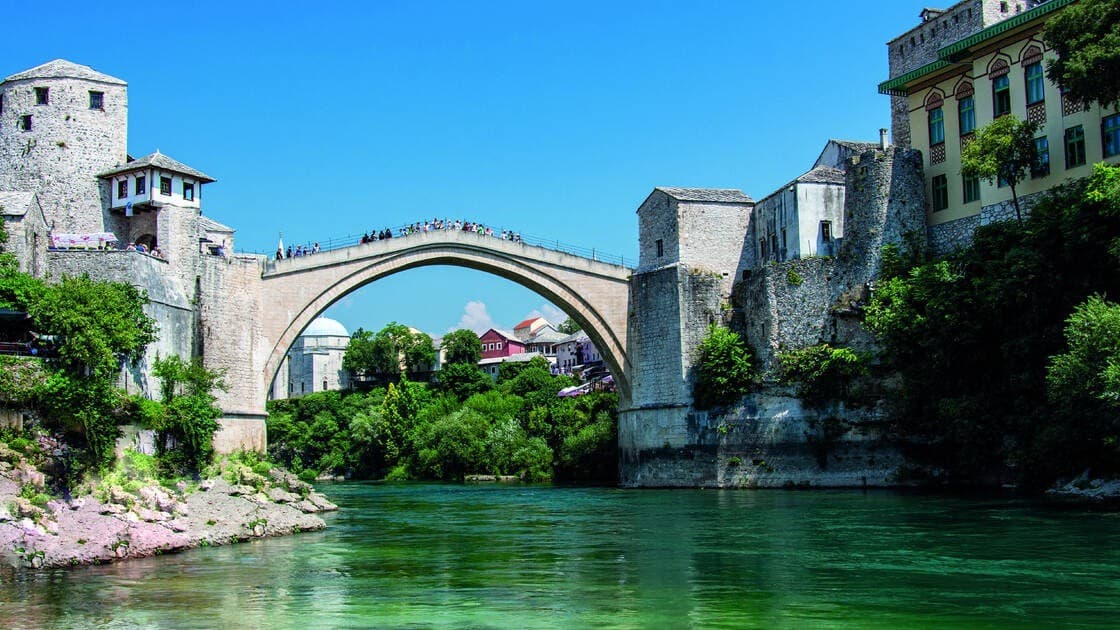
Philippe told us the legend of the Old Bridge. Sultan Suleiman ordered his builder Hayreddin to create the most magnificent bridge in the world — promising gold if he succeeded, death if he failed. Twice the bridge collapsed. On the third attempt, it held, standing for 427 years until war brought it down.
Today, the rebuilt bridge once again arches across the Neretva River. Beneath it, the Mostari — once the "bridge keepers" who guarded crossings centuries ago — have taken on a different role today. Now they are the young men of Mostar, ever-present on the bridge, diving for money as both livelihood and spectacle. The jump is 22 meters into one of the coldest rivers in the world. Done correctly, it is breathtaking. Done badly, it is like hitting concrete.
Bridges fall, bridges rise, and someone always keeps watch over them — in the past as guardians, today as divers who ensure the bridge is never without witness.
The Old Bridge Today
Later, I found myself sitting at a restaurant overlooking the Old Bridge and the Neretva River. The same bridge Philippe had described with such drama, the same bridge that once collapsed under Ottoman ambition, that once fell under artillery fire, now stood whole again — white stone against blue sky.
A young Mostari stood poised on the ledge. Below, tourists gathered euros into a hat. When the amount was enough, he splashed himself with cold water, steadied his breath, and leapt.
It was both daring and ordinary, myth and livelihood. For the people of Mostar, it is simply life.
The Music of the Falls
Not far from Mostar lie the Kravica Falls — a cascade of green and white water spilling into a turquoise pool. Our guide described it as "the music of the falls."
In spring, when the river runs cold and clear, migrating birds from the north stop here to nest. By May and July, their calls mix with the roar of water: kra-kra-kra-kra.
It is a reminder that Bosnia and Herzegovina is not only a land of scars but also of beauty. A place where rivers carve canyons, where waterfalls sing, where life returns each spring with its own chorus.
Closing Reflection
Bosnia and Herzegovina is a land of bridges — Ottoman arches, Austro-Hungarian schools, Yugoslav boulevards, rebuilt connections across divides. Some have fallen. Others have endured. All of them carry meaning.
Leadership here is not abstract. It is survival, humor, conscience, and courage. It is Ivanka's grief turned into wisdom. It is Philippe's irony turned into resilience. It is Mandlbaum's choice to see neighbors instead of enemies.
And this is the lesson for us today: leadership is never neutral. Leaders shape culture not only by who they are but by the systems they create and enforce. Structures will always win, which is why leaders must design them carefully — toward trust, dignity, and connection, not fear and division.
Bridges and waterfalls remind us: division may destroy, but connection and renewal can be rebuilt. The task of leadership — in nations, in companies, in communities — is to choose the latter.